
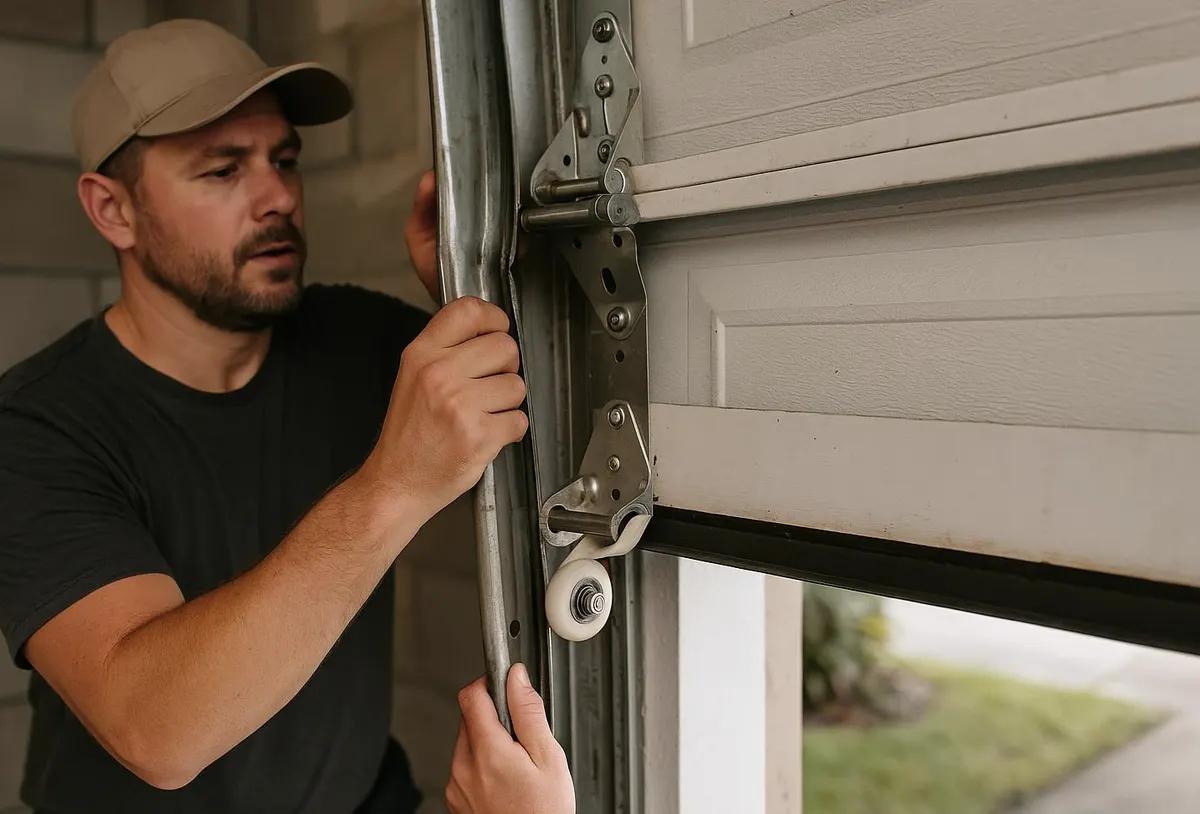
Your garage door is the largest moving opening in your home's exterior, and most residential doors simply aren't built to resist the wind pressures that nor'easters and coastal storms push through New Castle County. When wind forces a weak door inward, it pressurizes the entire structure from the inside out, putting stress on the roof and walls that they were never designed to handle. Reinforcing the garage door before severe weather arrives is one of the most effective, and most overlooked, things a homeowner can do.
Why a Garage Door Fails Before Anything Else
A standard double garage door covers roughly 16 by 7 feet of exterior wall, but unlike the framed walls around it, that opening is filled with thin panels riding in a track, held by rollers, hinges, and a spring system. None of that is engineered to carry structural wind load the way a stud wall is. In a mix of older and newer housing like you find throughout Wilmington, Newark, and Elsmere, the gap is even wider: older doors were often built light, with thinner steel or wood panels and no internal bracing, because wind-load ratings simply weren't part of the conversation when they were installed decades ago.
Once wind gets a door moving, bowing panels and loose track hardware fail quickly, and rain driven by coastal storms finds every gap at the edges. That combination of structural failure and water intrusion is why insurers and engineers both treat the garage door as the weak point in a home's wind defense.
Signs Your Door Won't Hold Up This Season
- Visible flex or bowing in the panels when the door is closed and wind hits it, even moderate gusts.
- Sagging or bent track, which lets the door rattle, shift, or pop out of alignment under pressure.
- Gaps along the edges or bottom where daylight, wind, or water gets through.
- Cracked, torn, or flattened weatherstripping, often from a summer of heat and UV exposure that leaves it brittle by fall.
- Rust on hinges, rollers, or track bolts, common after a humid summer and accelerated once winter road salt and moisture set in.
- No battery backup on the opener, which matters when a storm knocks out power and you need to get a vehicle out or secure the door manually.
Steps to Storm-Proof the Door Before Winter Storms Hit
- Inspect and tighten every bolt on the track, hinges, and roller brackets. Loose hardware is usually the first thing to give way under wind load.
- Check for or add horizontal bracing on the back of the panels. Retrofit wind-bracing kits are a relatively affordable fix, generally in the $50–$150 range nationally, but they only work on a door that's already structurally sound. A sagging or warped door needs more than bracing.
- Replace worn weatherstripping along the bottom seal and the side and top astragal. This is cheap, fast, and directly addresses both wind intrusion and the heavy rain this region gets in fall and winter storms.
- Check roller condition. Nylon rollers run quieter and handle temperature swings well; steel rollers are more durable under heavier wind-driven stress but need regular lubrication to avoid binding in cold weather.
- Confirm the opener has battery backup and that the manual release cord works smoothly, so the door can still be operated or secured if the power goes out mid-storm.
- Consider a wind-rated replacement if the door is original to an older home and shows multiple signs of wear. A full wind-rated door replacement typically falls in the $1,500–$3,500 range nationally, a bigger investment but the right call for doors with chronic structural issues.
- Clear gutters and downspouts near the garage so water doesn't pool against the threshold during heavy rain, which can seep under the door and freeze once temperatures drop.
Trade-offs worth knowing
Bracing kits and weatherstripping are low-cost, low-disruption fixes, but they're a patch, not a cure, for a door with a bent track or warped panels. If your door already rattles or visibly flexes before you've added any reinforcement, a retrofit kit will buy limited protection. On the other hand, replacing a door outright is the more permanent solution but costs more upfront and takes more time to schedule and install, so it's worth weighing against how exposed your home is to coastal wind and how old the existing door already is.
Icy Winters Add a Second Risk
Once storm season gives way to the icy stretch of winter that follows, a new set of problems shows up. Freeze-thaw cycles can crack weatherstripping that survived the fall, ice buildup in the track can bind rollers and strain the opener motor, and cold temperatures make springs more likely to snap under tension, often right when you need the door to open in a hurry. Addressing storm readiness now also sets the door up to handle the cold months better.
When to Call Wilmington Door & Opener
If you're seeing flex in the panels, gaps around the edges, rust on the hardware, or you're just not sure whether your door can take a direct hit of coastal wind this season, that's the point to call in a professional rather than guess. Wilmington Door & Opener's Garage Door Maintenance service covers a full inspection of track alignment, rollers, hinges, and weatherstripping, catching the small issues before a storm turns them into bigger ones. If the inspection turns up a spring under strain from age or cold, our Spring Replacement service handles that safely, since a spring failure during a storm is one of the more dangerous and disruptive things that can happen to a garage door. We'll tell you plainly whether bracing and maintenance will get your door through the season or whether it's time to talk about replacement.
If you're in Wilmington, Newark, Pike Creek, Hockessin, Elsmere, New Castle, Bear, or Claymont and want your garage door checked before the next storm rolls in, call Wilmington Door & Opener today to schedule a storm-readiness inspection.